Video-security breaches happen far too often. Our mission is to protect privacy. LockedStream secures your existing video AI surveillance system. Plain English defines the policies that decide who can watch. LockedStream keeps surveillance video of your kids, your elderly loved ones, and your employees private by default.
Runs on the cameras you already own · Open-source edition free forever
Schools, hospitals, warehouses, and homes are blanketed with cameras — but the footage they produce moves across networks, clouds, and inboxes with essentially no content protection at all. The industry keeps having data breaches, exposing video. Nobody has secured the video.
A single breach exposed live feeds from inside schools, hospitals, jails, and factories — footage that was never wrapped in the protection a movie gets by default.
License-plate and community cameras have continued to expose unencrypted live video — surveillance sold as “security” that leaves the footage itself in the clear.
Each added camera compounds liability under FERPA, HIPAA, and GDPR — without adding a shred of control over who can actually watch.
Every two-hour movie you buy or stream is wrapped in encryption, rotating keys, and hardware-backed DRM, to prevent piracy. LockedStream applies those same technologies to the footage of your kids, your parents, and your team, to ensure privacy.
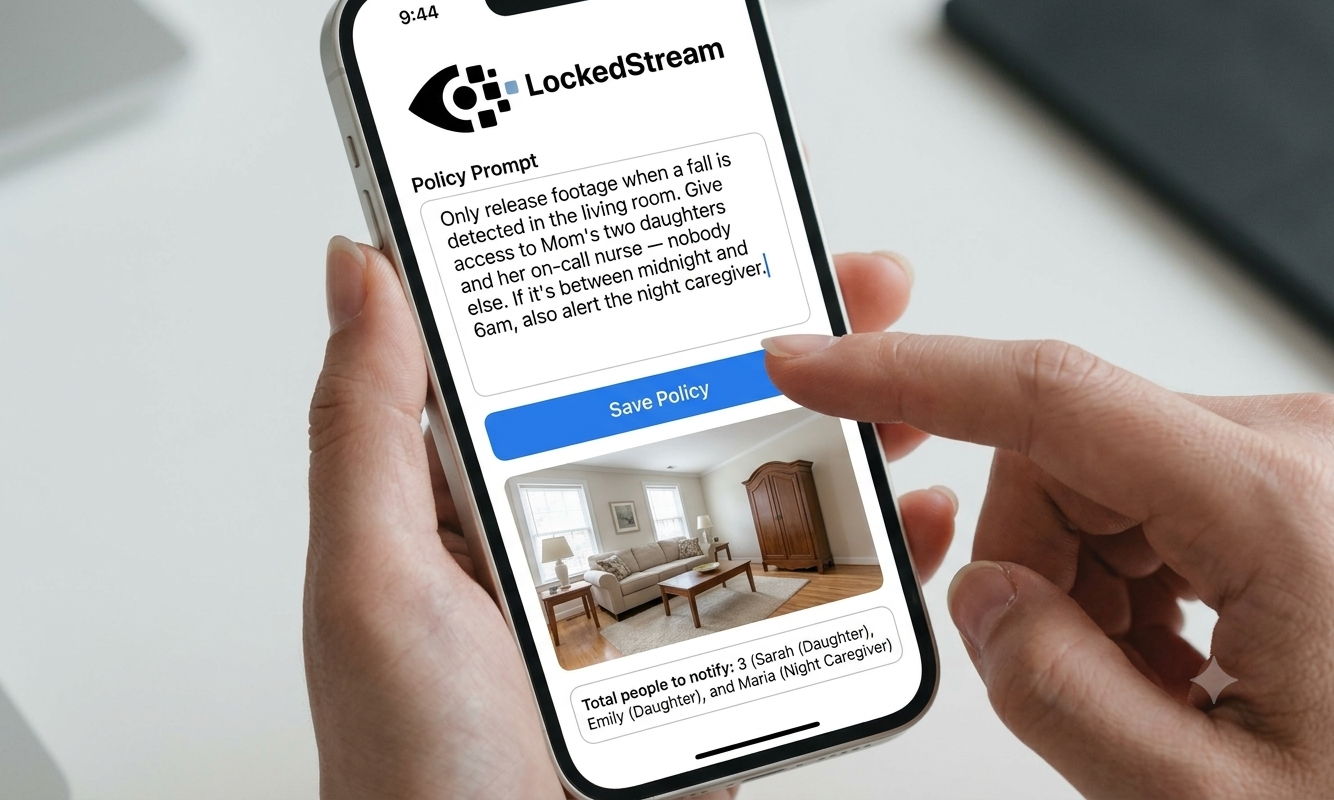
Say “only release footage when a fall is detected” — it becomes policy.
Dry-run policies against what-if scenarios to see exactly who would get access.
On-prem or cloud — private by default either way.
Every clip is encrypted the instant it's recorded, with a key that rotates every 5 seconds. Footage stays sealed at rest and in transit.
Decryption keys are held back by default. Storage admins, cloud providers, and anyone who copies a disk get encrypted noise.
A key is released only when the AI detects an event — a fall, a fire, a theft — or your policy criteria are met, and only for the relevant clips.
Keys go to the specific roles your policy authorizes — a caregiver, a facilities manager, the police — and no one else.
LockedStream is middleware for integrators and vendors — drop it in as a Python SDK, no rip-and-replace. Seal footage at capture, link clips to whatever the AI detects, and let the policy agent handle key release, role checks, and the audit trail. No cryptography to wire up yourself.
ls.lock(video_clip) encrypts a clip the instant it's recorded.
ls.attribute(video_clips, ai_event.category) links the relevant clips to what your model detected.
Working with a live stream instead of clips? Mark the start and end timepoints of the span.
Key release, role-based access, and the signed audit trail — all enforced for you.
The same core protection, packaged for home tinkerers and for facilities running thousands of cameras.
Widevine, PlayReady, and FairPlay already ship on billions of devices, and modern cameras can run apps and encrypt encoded video. We're composing the same content-protection stack that protects Netflix, the Apple App Store, and Amazon Kindle — and aiming it at surveillance footage.
LockedStream is built by the team at Scenera, Inc. — with deep roots in the standards that protect the world's premium video.
Two decades building computer-vision and edge-AI systems (Brain Corp, LeEco, Scenera). Ph.D. in computational cognitive neuroscience. pakl.net
Contributor to MPEG content-security standards, including the forensic watermarking that protects the world's premium video. Now aiming that expertise at surveillance.
Creator of HDMI and DVI — the standards that carry protected video to nearly every screen on earth. Unmatched depth in how content protection ships at scale.
See LockedStream running on the cameras you already own — or get notified when the open-source edition ships.